
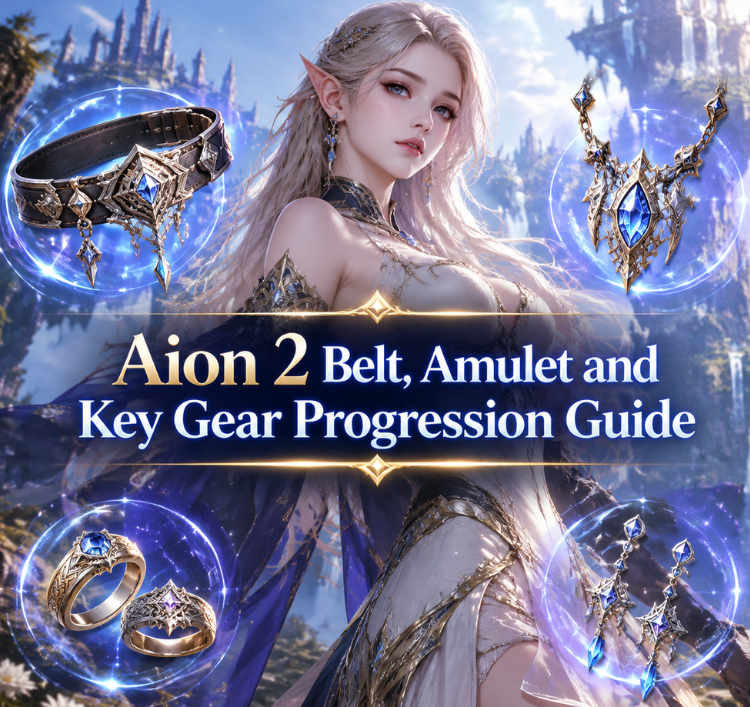
When players think about gear progression in Aion 2, weapons and armor usually receive most of the attention. However, several accessory slots can have an important impact on overall character performance. Belts, amulets, rings, earrings, and other accessories can provide valuable attributes, and ignoring these slots can leave a character weaker than its overall Item Level suggests.
After reaching the higher stages of progression, players should therefore look beyond their main armor set and build a complete equipment setup. A balanced approach also helps prevent unnecessary spending of Aion 2 Kinah on upgrades that will soon be replaced.
Why Accessories Matter
Accessories are not simply extra equipment slots. They can provide attributes that complement the main stats on weapons and armor.
A character with a strong weapon but outdated accessories may still struggle to reach the desired damage, defense, or survivability. This becomes increasingly noticeable when entering more demanding PvE content.
For this reason, accessory progression should happen alongside your main gear rather than being postponed indefinitely.
The key accessory categories include:
- Belt
- Amulet
- Rings
- Earrings
Other accessory slots available to the character
Each piece should be evaluated based on both Item Level and the attributes it provides.
Belt Progression
The belt is an easy slot to overlook because it does not have the same visual importance as a weapon or chest piece. Nevertheless, replacing an outdated belt can provide a useful increase in overall character power.
When upgrading your belt, compare the Item Level first and then examine the actual attributes. A higher-level belt is generally attractive for progression, but a slightly lower-level item with better stats for your build can remain competitive.
DPS classes should look for attributes that support their primary damage setup, while Templar and other defensive builds should pay more attention to survivability.
Do not spend excessive resources perfecting an early belt. Accessory upgrades become more worthwhile once you obtain a piece that can remain useful for a longer period.
Amulet Progression
The amulet is another important accessory slot that deserves attention during character progression.
Because accessories can contribute useful offensive or defensive attributes, an upgraded amulet can complement the rest of your equipment rather than simply increasing Item Level.
For damage-focused characters, prioritize attributes that work with the class’s primary combat style. Assassin and Ranger may prefer different offensive priorities from Sorcerer or Spiritmaster, while Cleric and Templar have their own role-specific requirements.
The best amulet is therefore not necessarily the one with the highest number attached to it. Always compare the complete stat package.
Rings and Earrings
Rings and earrings are equally important when completing an equipment setup.
These slots are particularly useful when fine-tuning a build because their attributes can help fill gaps left by the main armor pieces.
For example, if your character already has enough of one offensive attribute, a different accessory may provide better overall value by improving another part of your build.
This is why accessory progression should be viewed as a complete system rather than a race to replace every item with the highest Item Level available.
What Should You Upgrade First?
After level 45, a practical progression order can look like this:
Weapon → Main armor → Belt → Amulet → Rings and Earrings → Stat optimization
This does not mean every character must follow the exact same order. If you obtain an unusually strong accessory from PvE content, it can make sense to equip and improve it immediately.
The main principle is to avoid leaving one equipment category far behind.
A character with excellent armor but extremely outdated accessories has an obvious weakness in its overall setup.
Match Accessories to Your Class
Different classes should approach accessory progression differently.
- Assassin: Focus on attributes that support burst damage and melee pressure.
- Ranger: Prioritize stats that improve consistent ranged damage.
- Sorcerer: Look for attributes that complement magical damage and skill rotations.
- Spiritmaster: Balance offensive stats with the requirements of its summon-based combat style.
- Templar: Prioritize defensive and survivability-oriented attributes.
- Cleric: Look for stats that support healing performance while maintaining enough durability.
Following another player’s accessory setup without considering your own class can result in inefficient upgrades.
When Should You Enhance Accessories?
Enhancement resources should generally be reserved for accessories that you expect to keep.
There is little value in heavily investing in a temporary belt or amulet simply because it is slightly stronger than your currentitem. Use temporary upgrades to meet progression requirements, then save more valuable resources for long-term equipment.
Once your accessory Item Levels are stable, you can begin optimizing their additional attributes and other upgrade systems.
Building a Complete Endgame Setup
Strong character progression in Aion 2 is not only about obtaining the best weapon. Every equipment slot contributes to the final build.
After securing a suitable weapon and armor set, gradually bring your belt, amulet, rings, and earrings up to an appropriate level. Then focus on attribute optimization and long-term enhancement.
Players looking to speed up their progression may also consider buy Aion 2 Boosting services when trying to reach harder content or obtain better equipment more efficiently.
The most important thing is to maintain balance. A complete equipment setup with consistent Item Levels and class-appropriate attributes will usually perform better than a character with one exceptional item surrounded by outdated gear. By treating belts, amulets, and other accessories as essential parts of progression, players can build a much stronger Aion 2 character for both PvE and PvP.




Leave a Reply